Prey and Competitors
Prey are vital for wolves in-game, as they provide food for themselves and pups.
Prey
Elk: The favorite main course for wolves.
Moose: A very large and dangerous meal.
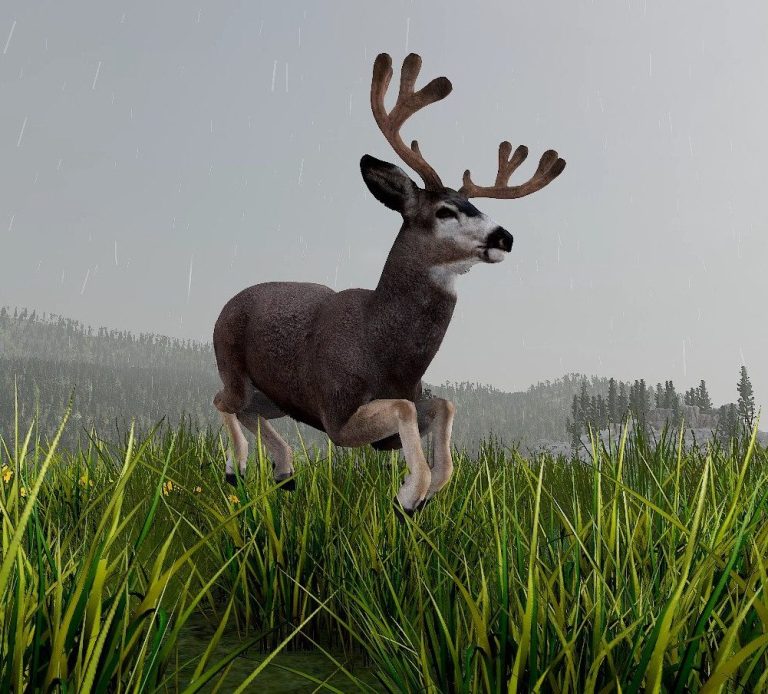
Mule Deer: Swift and agile, hard to catch.
Bison: Brawny old bulls are hard to beat.
Bighorn Sheep: Nimble climbers stay out of reach. Coming soon.
Snowshoe Hare: A sprinting, zig-zagging snack.
Beaver: Safe in the water, slow on land.
Pronghorn: Putting the fast into fast food.
Domestic Livestock: Wolves that leave Yellowstone National Park may prey on sheep, cattle and other domestic livestock. - Credits
Competitors
Wolf: Fierce and territorial, other wolf packs are a wolf's biggest worry.
Coyote: Smart and persistant. A wolf's least favorite canid cousin.
Grizzly Bear: Large and in charge! Smart wolves steer clear of grizzlies.
Cougar: Stealthy and solitary, this competitive cat is not a wolf's best friend.
Red Fox: Swift and cautious, foxes will wait for leftovers from your kills.
Eagles: Happy to snack out of reach at your kills...or snatch an unwatched pup.
Raven: Greedy, univited dinner guests. Handy beacons.
Wolverine: Fierce, large weasles with formidible skills!
Lynx: Elusive lynx tend to stay out of wolves' way.
Black Bear: WolfQuest wolves don't have to worry about black bears...yet! Coming soon. - Credits
Elk
Elk are Yellowstone’s most abundant ungulate, with 10,000 to 20,000 roaming in large and small herds throughout the park. This creates a paradise for wolves and a key reason of why Yellowstone was chosen for wolf reintroduction. Elk comprise about 90% of winter wolf kills and are also an important food source for bears, mountain lions, and at least 12 scavenger species, including eagles, ravens, foxes, and coyotes.
Autumn in Yellowstone is ungulate mating season (rut). Bull elk spend the summer eating and growing antlers in preparation for a chance to pass on their genes. The strongest bull elk control access to harems of about six cows with their calves. During the rut, dominant bulls have to work around the clock keeping their harems together and away from other bulls, bugling and driving off the competition. Would be usurpers test and challenge the dominant bull hoping to defeat him and take his place.
Bulls of similar strength battle, locking antlers and pushing vigorously to establish dominance. Sometimes they are injured fighting but bulls rarely die in the rut. The loser gives up and the winner goes back to patrolling his harem as long as he is able.
After the rut, the bulls gather together in small male groups for winter, spring and summer. The female groups congregate in larger herds for the winter, led by experienced matriarchs. These herds move to lower elevations in search of winter forage.
Elk cows give birth to single calves in May to late June. Newborn ungulates rely on staying hidden until they can keep up with their mothers and join the herd. Many calves are eaten by wolves, coyotes, black and grizzly bears, cougars, and golden eagles.
Moose
Moose are the largest members of the deer family and one of the largest mammals in Yellowstone. A moose would make a hearty meal for a pack of wolves – if they can take it down. Moose have formidable defenses, so healthy adults are rarely killed. Predators have more luck with sick or old moose, or calves.
Moose may look awkward but their long legs are well-suited to run fast, wade and swim in water, and move through deep snow. Male moose grow huge antlers each year. A flap of skin known as a "bell" dangles under the neck and has no known function.
Mule Deer
Mule deer are named for their large ears. They live in varied habitats throughout Yellowstone: brushy areas, grasslands, and coniferous forests.
Wolves sometimes prey on mule deer, especially fawns, although they usually prefer larger, slower elk. Mule deer often use a distinctive bounding leap called stotting (or pronking) which allows them to cover uneven terrain efficiently and may signal their health (don't bother chasing me, Big Bad Wolf!). This makes them challenging prey to catch. Mule deer also have sharp hooves and pointy antlers which smart wolves avoid.
Mule deer live in small family groups rather than large herds. In the fall, the does gather around dominant bucks for the rut (mating season). Like other ungulates, the males spar, posture, and try to drive away other bucks. Of course, they would rather win by looking strong and awesome rather than risk injury fighting. But evenly matched mule deer bucks will clash, locking antlers and shoving vigorously to prove who is the boss. Such battles are exhausting and can cause injuries, some fatal. The winner gets the does and passes his genes to a new generation.
In the spring and early summer, mule deer does usually give birth to two fawns. Fawns start out hiding motionless, well camouflaged and scentless. Once they are mobile, fawns stay close to their mothers and can also run fast. Fawns are preyed on by wolves, coyotes, black and grizzly bears, cougars, and golden eagles.
Pronghorn
A small population of pronghorn live in Yellowstone's Northern Range, preferring the open grassland of the Lamar Valley. Pronghorn evolved to outrun a now-extinct cheetah, so healthy adults are very hard for today's predators to catch. Wolves know there are many easier meals to be had.
Newborn fawns hidden in the grass, however, provide meals to many predators in late spring and early summer. Once fawns can keep up with their mothers, predators once again look for more attainable prey.
Pronghorn live in small family groups for protection. If they spot a threat with their large eyes, they flare the white fur on their rumps to signal danger to others. Like other ungulates, they also have sharp hooves which can deal damage to unwitting wolves.
Bison
Bison are the largest land-dwelling mammal in North America so wolves and grizzly bears are the only large predators of adult bison. Bison have become inceasingly common in Yellowstone National Park but most wolves steer clear of bison.
Wolves will always go for the prey that offers the most food for the least amount of risk. While bison are massive (definitely the most food), they are so dangerous that only some wolf packs will take them on. A bison can easily kill or critically injure a wolf and it takes a lot of hunting cooperation to bring one down. However, when their preferred prey (elk) are not around, some larger packs have turned to hunting bison – especially in the winter, since bison don't migrate. It takes a big wolf pack (5-10 wolves is optimal) to take down an adult bison. A successful bison hunt usually relies on having bigger, experienced males in the wolf pack.
Bighorn Sheep
About 150 bighorn sheep live in Yellowstone near steep terrain where they can stay safe from predators. Bighorns are occasionally eaten by wolves but there are certainly easier meals to be had than these agile ungulates. Bighorn sheep numbers have actually increased since wolf restoration began in 1995, possibly because of the decrease in elk, a main food competitor.
Like other ungulates, males battle in autumn, ramming rivals with their big horns. Like their name says, they have horns, not antlers. Horns are not shed and keep growing. So, the bigger and curlier the horns, the older the ram.
Snowshoe Hare
Snowshoe hares are common in many Yellowstone habitats. They are known for their large snowshoe feet and their changing camouflage–brown in the summer and white in the winter. Hares eat plants and prefer to hide in forest underbrush.
In real life, hares are very fast and agile, making them hard to catch. A hare would only provide a wolf with a light snack for a lot of work, so are not a main food source for wolves. However, lynx, bobcats, coyotes, foxes, weasels, some hawks, and great horned owls also hunt hares. Good thing hares have lots and lots of babies!
Beaver
Beavers are large rodents well known for their skills at building dams and impregnable lodges. Their dams change landscapes by raising water levels, providing new habitat for many plants and animals.
There are more than 100 colonies of beavers in Yellowstone National Park. Peaceful, social beavers are safe in the water where they can dive to safety at the warning slap of a tail. Sometimes beavers are preyed on by patient predators if they can catch them by surprise on land.
Domestic Livestock
Humans and wolves have a long, complicated history and, like other top predators, they often compete for resources. Wolves living within Yellowstone National Park hunt the abundant wild prey found there. But since wolves don't recognize park boundaries, they sometimes cross over into the Greater Yellowstone Area where they may encounter fat, slow, domestic livestock.
Animals such as sheep or cattle, left unguarded, are obviously much easier prey to kill than fleet, dangerous elk and bison. However, preying on livestock is actually one of the most dangerous things a wolf can do! While ranchers are reimbursed by the U.S. government for livestock losses, they don't take kindly to predation of their animals. Wolves that habitually prey on livestock don't survive very long. People are allowed to hunt and trap wolves outside the park. Once wolves leave the park, humans are the number one cause of death.
In WolfQuest, we wanted to recognize that wolves do sometimes prey on livestock and the wolf-human relationship can be competitive. So we included a cattle ranch in Lost River (DLC) and as side mission in WQ 2.7 in single player mode. The gameplay is meant to be challenging and not very rewarding, in terms of food. It is difficult to hunt at the ranch without alerting the rancher and having them attempt to discourage predation. The cattle ranch is meant to educate players that domestic livestock are not the easy meal they may appear to be and wolves that hunt on ranches often pay with their lives.